
Rainwater collected from a roof in Canada is not inherently clean water. It passes over a surface that accumulates debris, dust, bird droppings, pollen, and in urban and peri-urban areas, atmospheric pollutants. What it is, in most situations, is relatively low in dissolved minerals compared to groundwater — which makes it well suited for irrigation and, after appropriate treatment, for various household uses.
The treatment level required depends entirely on what you intend to do with the water. This article works through the filtration stages from simplest to most comprehensive, mapped to the end uses they support.
Understanding What Is in Collected Rainwater
Roof runoff typically contains:
- Sediment and particulates — dust, sand, decomposed organic matter from gutters and the roof surface.
- Biological material — bacteria, fungi, and in some cases protozoa such as Cryptosporidium and Giardia, introduced by bird and animal droppings on the roof.
- Dissolved compounds — materials leached from roofing (zinc from galvanized steel, compounds from asphalt shingles), atmospheric nitrogen and sulfur in areas with air quality concerns.
- Pesticides and herbicides — in agricultural regions where aerial application occurs, or from nearby fields during dry, windy conditions.
A well-functioning first-flush diverter — described in the article on roof collection systems — removes the worst of the sediment and biological load before water enters the tank. Filtration treats what remains.
Filtration for Garden Irrigation
Plants are generally tolerant of water quality that would not be acceptable for human consumption. The main concerns for irrigation water are:
- Particulates that can clog drip emitters or sprinkler heads.
- Bacterial contamination when watering edible crops directly — particularly leafy greens harvested without cooking.
Sediment Screen or Mesh Filter
A 100–200 micron mesh filter installed between the tank outlet and the irrigation pump or hose connection removes most particles large enough to block emitters. These are inexpensive, available in standard garden hose fittings, and can be cleaned by back-flushing. For drip irrigation, a 75-micron filter provides an additional margin.
For watering edible crops, particularly crops consumed raw, many growers keep the water directed to the base of plants and soil rather than directly onto edible leaf surfaces. This reduces the risk of surface contamination independent of filtration.
Filtration for Non-Potable Indoor Use
Non-potable indoor applications — toilet flushing, laundry — bring rainwater inside the house but do not involve consumption. The relevant concerns shift from taste and pathogens to equipment protection and odour.
Stage 1: Sediment Pre-Filter
A 5-micron cartridge filter installed at the point where water enters the household distribution line removes suspended particles that would otherwise accumulate in toilet cisterns and washing machine components. Cartridges typically require replacement every three to six months depending on water quality and volume used.
Stage 2: Activated Carbon Filter
An activated carbon block filter following the sediment stage removes chlorine (if any has been added to the tank), dissolved organic compounds responsible for colour or odour, and some pesticide residues. Carbon filters have a finite capacity and must be replaced on schedule — most cartridges serving a non-potable indoor system are rated for 6–12 months of use. An expired carbon filter that is not replaced can become a biological growth medium.
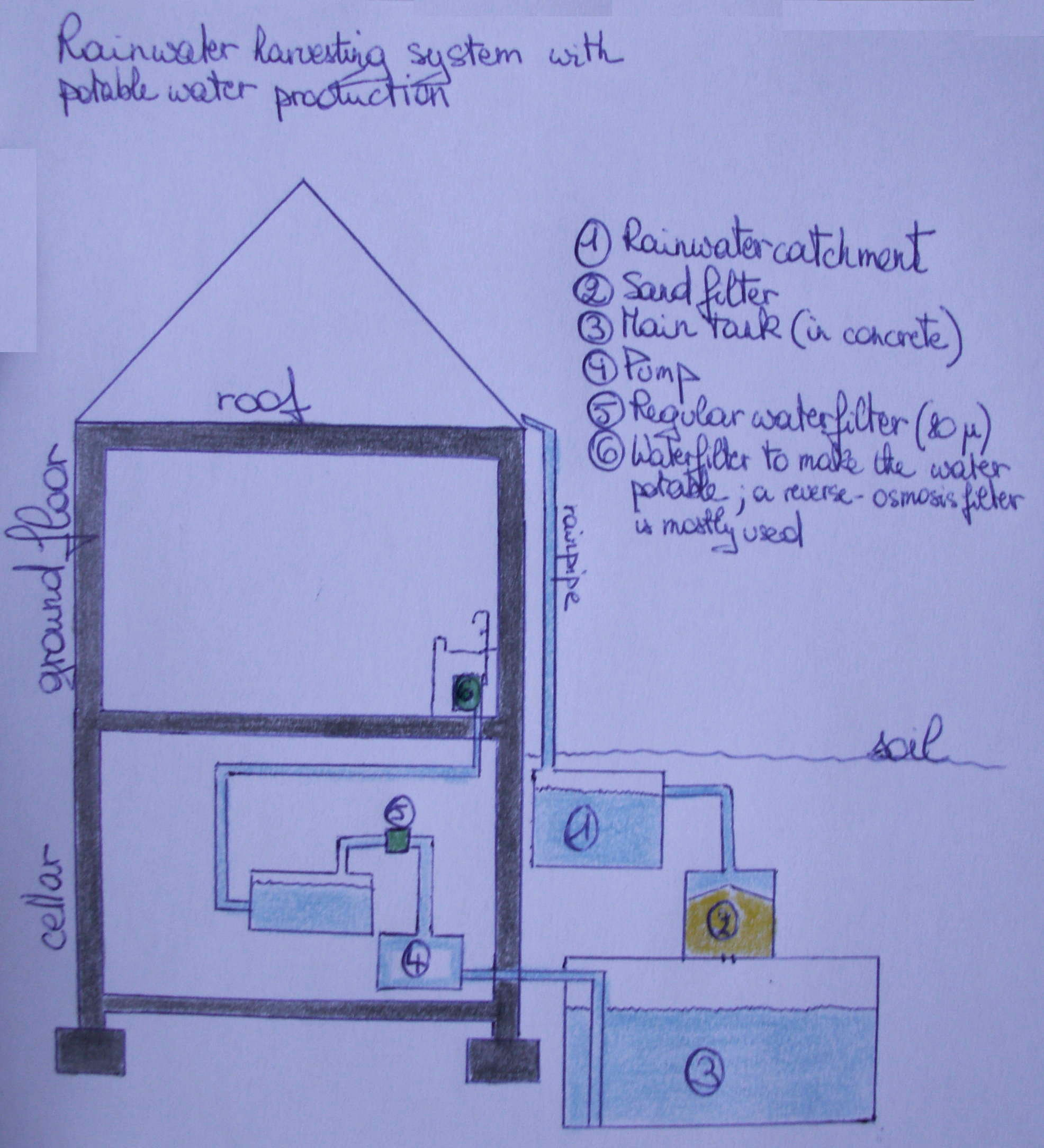
Filtration for Potable Use
Using rainwater as a source of drinking water — even as a supplement to a well — is the most complex and regulated application. Most Canadian provincial health authorities require that any system providing drinking water meet the Guidelines for Canadian Drinking Water Quality published by Health Canada. Achieving this with roof-collected rainwater requires a multi-stage treatment train.
Stage 1: Sediment Pre-Filter (100 micron)
Removes coarse particulates before they load the finer stages downstream.
Stage 2: Fine Sediment Filter (1–5 micron)
Removes fine silt and particulates. This stage protects the UV lamp and ensures the UV dose reaches pathogens rather than being absorbed by turbid water.
Stage 3: Activated Carbon Block (0.5–1 micron)
Removes dissolved organic matter, pesticide traces, and colour. A block carbon filter at this pore size also reduces some biological particles including Cryptosporidium oocysts, which are not reliably inactivated by UV.
Stage 4: UV Disinfection
Ultraviolet disinfection at a dose of 40 mJ/cm² — the standard specified by the NSF/ANSI 55 Class A rating — inactivates bacteria, viruses, and most protozoa. UV systems require clear water to be effective, which is why the preceding filtration stages matter. UV bulbs degrade over time regardless of use; most manufacturers specify annual replacement for systems in continuous service.
Optional Stage: Reverse Osmosis
Reverse osmosis (RO) removes dissolved minerals, heavy metals, and a broad range of chemical contaminants, and produces water that meets drinking water standards across most parameters. It is appropriate on properties where the catchment surface introduces measurable dissolved contaminants — older asphalt roofs with detectable PAH levels, or galvanized metal roofing with elevated zinc. RO systems waste a significant volume of water in the concentration stream — typically two to four litres rejected per litre produced — which limits their practicality on a rainwater supply where volume is the constraint.
Regulatory Considerations for Potable Use
In British Columbia, the Drinking Water Protection Regulation under the Drinking Water Protection Act governs drinking water sources. Rainwater systems providing water to multiple residences or as a primary supply to any residence may require approval from a Drinking Water Officer. Single-household use for supplementary supply is less clearly defined. Ontario's Safe Drinking Water Act similarly imposes obligations on anyone operating a system providing water to others for consumption.
For a single rural household using rainwater as a supplement to a tested well — for example, using rainwater for toilet flushing and well water for drinking — regulatory complexity is low. For a system intended to supply potable water as the primary source, contact your provincial Ministry of Environment or Health authority before finalising the design.
Tank Chlorination as an Alternative
Some rural property owners add food-grade sodium hypochlorite (unscented household bleach) to storage tanks as a simple disinfection measure, particularly for non-potable indoor use. The WHO and Health Canada guidance for emergency water treatment suggests 0.5 mg/L free chlorine residual as a minimum for disinfected storage water. Achieving this in a large tank requires knowing the volume and testing the residual with inexpensive pool test strips.
Chlorination is not a substitute for filtration — it does not remove sediment, chemical contaminants, or Cryptosporidium oocysts, which are highly chlorine-resistant. It is best understood as an additional layer of protection for non-potable applications where sediment filtration is already in place.
System Maintenance and Water Quality Monitoring
A filtration system that is not maintained provides false assurance. Practical maintenance points:
- Replace sediment cartridges before they reach the manufacturer's rated capacity — turbidity in the outlet water is a sign they are overdue.
- Replace carbon filters on schedule regardless of visible water quality — carbon depletion is not visible.
- Replace UV bulbs annually or per the manufacturer's recommendation, and clean the quartz sleeve protecting the bulb at each replacement.
- Test stored water annually for total coliforms and E. coli if it is used for any food-contact purpose. Water testing kits are available through provincial environmental labs and some private laboratories.
The full rainwater system — catchment, storage, and treatment — works as a chain. The guides on roof collection and storage tanks cover the upstream components.